What Is A Laser Ranging Sensor?
Aug 21, 2019
What is a laser ranging sensor?
The laser ranging sensor is an instrument that uses a laser to accurately measure the distance of a target. The laser ranging sensor emits a very thin laser beam to the target during operation, and the photoelectric component receives the laser beam reflected by the target. The timer measures the time from the transmission to the reception of the laser beam, and calculates the distance from the observer to the target. The laser ranging sensor is light in weight, small in size, simple in operation, fast and accurate, and its error is only one-fifth to one-hundredth of the other optical ranging sensors.
The laser ranging sensor is an instrument that uses a laser to accurately measure the distance of a target. The laser ranging sensor emits a very thin laser beam to the target during operation, and the photoelectric component receives the laser beam reflected by the target. The timer measures the time from the transmission to the reception of the laser beam, and calculates the distance from the observer to the target.
If the laser is continuously launched, the measuring range can be up to 40 kilometers, and it can work day and night. If the laser is pulsed, the absolute accuracy is generally low, but for long-distance measurement, good relative accuracy can be achieved.
Due to the continuous price reduction of laser ranging sensors, the industry has gradually begun to use laser ranging sensors. At present, there are a number of new miniature ranging sensors with the advantages of fast measuring distance, small size and reliable performance, which can be widely used in industrial measurement and control, mining, port and other fields.
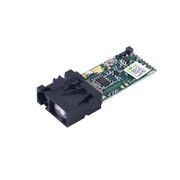
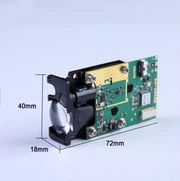
Laser is a new technology developed in the 1960s. It is a light that is very pure in color, highly concentrated in energy, and very directional. A laser ranging sensor is an instrument that uses a laser to perform ranging. Its principle of action is simple: the distance is determined by measuring the time at which the laser begins to emit and the laser is reflected back from the target. For example, a laser ranging sensor is used to measure the distance of the moon. If the time from the start of the laser to the reflection from the moon is determined to be 2.56 seconds, the one-shot time of the laser to the moon is equal to 1.28 seconds, and the speed of the laser is the speed of light, which is equal to 300,000 kilometers per second. Therefore, the measured distance of the moon from the Earth is the product of the one-way time and the speed of light, that is, 384,000 kilometers. In order to transmit and receive laser light and perform timing, the laser ranging sensor is composed of a laser transmitter, a receiver, a clock frequency oscillator, and a distance counter.
Laser ranging sensors can also be used to track ranging from artificial satellites, measure aircraft flight altitude, aim and measure targets, and perform topographic mapping and surveying.