Call Us: +86-28-68731157Email: info@jrt-measure.com
enLanguage

Laser Distance Sensor

What is Laser Distance Sensor?


Laser sensor is a kind of sensor which uses laser technology to measure. It is generally composed of laser, optical parts and photoelectric devices. It can convert the measured physical parameters (such as length, flow, speed, etc.) into optical signals, and then use photoelectric converter to convert the optical signals into electrical signals. Through the filtering, amplification and rectification of corresponding circuits, the output signals can be obtained, so as to calculate the measured quantity.

Advantages of Laser Distance Sensor

Wide Measurement Range And High Precision

The laser measuring sensor adopts phase and pulse measurement principles, with a measurement range of several meters to thousands of meters, and an accuracy of meters, centimeters, or even millimeters.


Non-contact Measurement

The laser range finder sensor adopts the laser linear method, which is directly reflected back to the receiver after detecting the distance, so that it does not need direct contact, and can measure some difficult-to-reach environments or untouchable targets.

Small Size, Easy To Integrate

For the need to integrate the laser measurement sensor into its equipment, our distance sensor is your rare choice. In order not to take up too much equipment space, we have developed a variety of small-volume laser rangefinder sensor, and the operation is simple, you can easy integration.

24 Hours Online Real-time Measurement

The laser range sensor can be used for single measurement or continuous measurement, and can be used in equipment systems that require remote control and real-time monitoring.


First 1234567 Last 1/17

why choose us


High quality

Our products are manufactured or executed to very high standards, using the finest materials and manufacturing processes.


Rich experience

Dedicated to strict quality control and attentive customer service, our experienced staff is always available to discuss your requirements and ensure complete customer satisfaction.


Quality control

We have professional personnel to monitor the production process, inspect the products and ensure that the final product meets the required quality level standards, guidelines and specifications.


24h online service

We try and respond to all concerns within 24 hours and our teams are always at your disposal in case of any emergencies.

 
What Can Laser Sensor Detect
 

Laser measurement of length

Precise measurement of length is one of the key technologies in precise machinery manufacturing industry and optical processing industry. Modern length measurement is mostly based on the interference phenomenon of light wave, and its accuracy mainly depends on the monochromaticity of light. Laser is the most ideal light source. It is 100 thousand times purer than the best monochromatic light source (krypton-86 lamp). Therefore, the laser measurement range of length is large and the accuracy is high.


According to the optical principle, the relationship between the maximum measurable length l of monochromatic light and wavelength λ and spectral line width δ is l = λ 2 / δ. The maximum measurable length of krypton-86 lamp is 38.5cm. For a long object, it is necessary to measure in sections to reduce the accuracy. If he-ne gas laser is used, it can measure tens of kilometers at most. Generally, the length within several meters can be measured with an accuracy of 0.1 μ m.

Laser measurement of distance

Its principle is the same as that of the radio radar. After the laser is aimed at the target, the round-trip time is measured, and then the round-trip distance is obtained by multiplying the speed of light. Because of the advantages of laser, such as high directivity, high monochromaticity and high power, these are very important for the measurement of long distance, the determination of target orientation, the improvement of signal-to-noise ratio of the receiving system, and the guarantee of measurement accuracy, so the laser rangefinder is paid more and more attention.


The lidar developed on the basis of the laser rangefinder can not only measure the distance, but also the azimuth, velocity and acceleration of the target. It has been successfully used in the ranging and tracking of the artificial satellite. For example, the lidar using ruby laser has a distance measuring range of 500-2000 km with an error of only a few meters. At present, ruby laser, neodymium glass laser, carbon dioxide laser and gas laser are often used as the light source of laser rangefinder.

Laser measurement of thickness

Based on the principle of triangle ranging, a precise laser ranging sensor is divided at the upper and lower part of the c-frame. The modulated laser emitted by the laser hits the surface of the measured object. By sampling the signal of the linear ccd, the distance between the measured object and the c-frame is synchronously obtained by the linear ccd camera under the control of the control circuit. The thickness of the middle measured object is calculated by the data fed back by the sensor. Because the detection is continuous, the continuous dynamic thickness of the measured object can be obtained.

Thickness measurement by single laser displacement sensor

Put the measured body on the measuring platform, measure the distance from the sensor to the platform surface, then measure the distance from the sensor to the measured body surface, and measure the thickness after calculation. It is required that there is no air gap between the measured body and the measuring platform, and the measured body is not cocked. These strict requirements can only be achieved offline.

Thickness measurement by double laser displacement sensor

A laser displacement sensor is installed above and below the measured body respectively, and the thickness of the measured body is d = c - (a + b). Among them, c is the distance between two sensors, a is the distance between the upper sensor and the measured body, and b is the distance between the lower sensor and the measured body. The advantage of this method for on-line thickness measurement is that it can eliminate the influence of the vibration of the measured body on the measurement results.


But at the same time, there are requirements for sensor installation and performance. The conditions to ensure the accuracy of measurement are that two sensor beams must be coaxial and that two sensor scans must be synchronous. Coaxiality is realized by installation, and synchronization depends on the selection of laser sensor with synchronization end.

Measuring Principle of Different Laser Distance Sensors
1000m 长距离激光距离传感器 TTL
1000m长望远镜传感器
激光距离传感器TTL输出
激光雷达传感器 100Hz

Pulse Laser Distance Sensor
A pulse laser with a very short duration is emitted by a pulsed laser, and after reaching the target to be measured after the distance to be measured, part of the energy will be reflected back. The reflected pulsed laser is called an echo. The echo returns to the rangefinder and is received by a photoelectric detector. According to the interval between the main wave signal and the echo signal, that is, when the laser pulse travels from the laser to the target to be measured, the distance of the target to be measured can be calculated. 


Phase Laser Distance Sensor
The emitted laser light is emphasized, and the phase change of the modulated signal is used when the laser is propagated in space. According to the wavelength of the modulated wave, the distance represented by the phase delay is calculated. That is, the indirect method of phase delay measurement is used instead of directly measuring the time required for the round trip of the laser to achieve distance measurement. The accuracy of this method can reach the millimeter level.


Triangulation Laser Distance Sensor
As mentioned above, this measurement principle is that the light emitted by the laser is focused on the surface of the measured object after being focused by the condensing lens, and the receiving lens receives the scattered light from the incident light spot and images it on the photoelectric  position detector on the sensitive side. When the object moves, the relative distance of the object movement is calculated by the displacement of the light spot on the imaging surface. The resolution of triangulation laser ranging is very high, which can reach the order of microns.  


Interferometric Laser Distance Sensor
By moving the measured target and measuring the coherence, the distance increment measurement is completed by counting, so the sensitivity of the interferometric measurement is very high, which can reach the nanometer level. 

Application of Laser Distance Sensor
 

Automotive industry

Laser sensors are widely used in the automotive industry for measuring distances, detecting objects, and for positioning and alignment. They are commonly used in advanced driver assistance systems (adas) and autonomous vehicles.

Manufacturing industry

Laser sensors are commonly used in the manufacturing industry for measuring distances, positioning, and alignment. They are used in automated assembly lines, robotics, and inspection systems to ensure accurate and precise measurements.

Aerospace industry

Laser sensors are used in the aerospace industry for measuring distances, positioning, and alignment. They are used in satellite tracking, aircraft navigation systems, and for testing and calibration of aircraft components.

Robotics

Laser sensors are commonly used in robotics for object detection, positioning, and navigation. They are used in industrial robots, autonomous robots, and in drones and uavs.

Working Principle of Laser Distance Sensor

First, the light travels from the sensor to the object. The light then bounces off the object back to the sensor.The sensor then calculates how long it took for the light to travel to and from the object to determine the distance.


If the object was within the sensor’s range, the output of the sensor will turn on. If the object was not in the sensor’s range the output will stay off.To set up when the laser sensor output turns on depends on what type of laser sensor you have. If it is just a basic laser sensor, you just turn a dial or a ring on the laser sensor to adjust it from its minimum setting to its maximum setting.


Other laser sensors have a display and buttons on them that are used to configure the sensor’s min/max settings. And other laser sensors require a computer to be connected to them to configure the min/max settings.

What You Should Know When Use Laser Distance Sensor


Pay Attention To The Effective Working Area Of The Sensor
Buyers should pay attention to the effective working area of the sensor when using the sensor. The range and length that need to be actually measured should be placed within the effective measurement area and reticle of the sensor. Due to structural reasons, the laser ranging sensor has certain measurement blind areas at both ends of the aiming head. Therefore, buyers should be careful not to place measuring objects in this area.


Note That The Metal Material Used To Assemble The Sensor Is Non-magnetic
When assembling, buyers need to note that if the hydraulic cylinder is made of ferromagnetic material, then when installing the sliding iron ring, a rubber magnetic isolation pad made of non-magnetic material should be placed under it. Since the accuracy of the laser ranging sensor is not affected by magnetic factors, all screws that fix the sliding magnetic ring must pass magnetic detection to avoid errors.


Pay Attention To The Color Influence Of The Object Being Measured
Because the color of the object being measured by the sensor will affect the correctness and accuracy of its measurement resolution. Targets with brighter and warmer colors have higher reflectance. The resolution parameters listed in the general catalog are for warm targets. The resolution of cold color targets is more than 4 times that of warm color targets. Therefore, when buyers use laser ranging sensors, they should pay attention to the impact of the color of the measured object on the resolution.

 
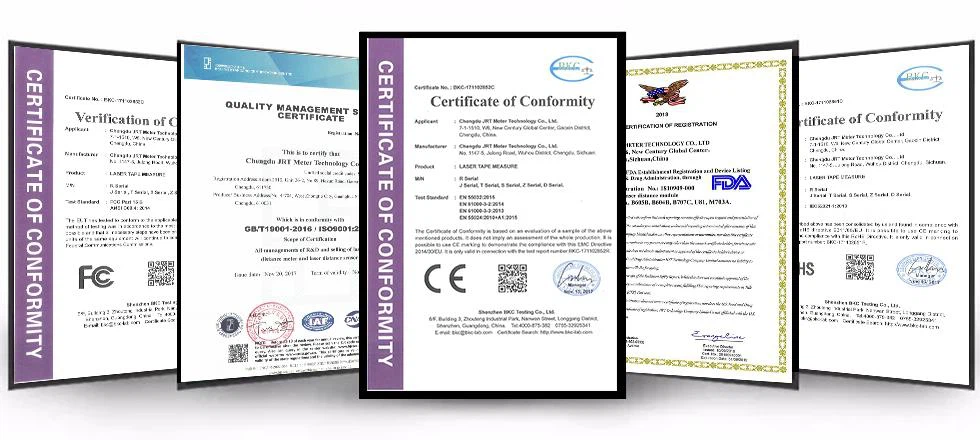
Certifications


productcate-1-1

 
Our Factory


We start as a technical services company, now we are the biggest laser distance sensor manufacture in china. In 2018, our u81, smallest phase-shift laser distance sensor is on market. In 2019, we started to produce lidar sensor. We are always r&d new and better laser sensors for all customers.

productcate-1-1

 
FAQ
 

Q: How does laser sensor work?

A: The basic principle is optical triangulation using a cmos linear imager. A diffuse triangulating laser distance sensor transmits a laser through a lens and to the target, which reflects the light back to the sensor. A lens focuses this reflected light into a small spot onto the cmos linear imager.

Q: What is the use of laser sensors?

A: The definition of a laser sensor is, it is an electrical device used to sense minute objects and precise positions. This sensor uses a laser to produce light within a straight line. Its visible ray mark of the laser makes the arrangement very simple. Laser light includes light waves with similar wavelengths.

Q: Is a laser sensor an optical sensor?

A: Laser sensors are a special kind of optical sensor. A laser is a very narrow beam of light of a single color with the same frequency that travels in the same direction. The word laser stands for light amplification by stimulated emission of radiation.

Q: Are laser sensors dangerous?

A: Improperly used laser devices are potentially dangerous. Effects can range from mild skin burns to irreversible injury to the skin and eye. The biological damage caused by lasers is produced through thermal, acoustical and photochemical processes.

Q: Is a laser a sensor?

A: A laser sensor uses a 'laser' to emit light in a straight line. Its visible beam spot makes alignment and positioning very easy. Since the light beam is focused, the sensor can be installed without worries about stray light. The major types of laser sensors include reflective, thru beam, and retro-reflective.

Q: What is the range of the laser sensor?

A: Laser distance sensors are designed for non-contact distance measurements: Laser gauges for measuring ranges up to 10m, laser distance sensors for up to 3,000m.

Q: What is cmos laser sensor?

A: A cmos image sensor combines with a step-less laser power adjustment algorithm to produce stable detection of all types of workpieces from black rubber with low reflectivity to stainless steel and other highly glossy materials.

Q: Which laser sensor is used for measuring very long distances?

A: Ldm301 laser distance sensor series – fast measurement of long distances. The laser distance sensors of the ldm301 series use a measured time-of-flight principle to measure distances of 300 m for natural surfaces and 3,000 m for reflective surfaces.

Q: How does a laser sensor measure distance?

A: The distance measurement is based on the triangulation principle. The laser beam strikes the object as a small point. The receiver of the sensor (photodiode line) detects the position of this point. The angle of incidence changes according to the distance, and thereby the position of the laser point on the receiver.

Q: How accurate are laser distance sensors?

A: Compared to other types of laser sensors, om70 sensors feature one of the thinnest beam shapes, helping to ensure a more precise measuring focus. For example, most point-type lasers typically only go down to 0.2mm x 0.75mm whereas the om70 goes down to 0.05mm x 0.05mm.

Q: Are laser distance measures accurate?

A: Most construction lasers will be accurate to 1/8 or 1/16 of an inch. For basic estimating, a laser measuring tape with a 1/8-inch accuracy will work fine. And even if you don't need to bump the tool up to 1/16-inch accuracy, longer-range models will have it available.

Q: How do distance sensors work?

A: Ultrasonic distance sensors measure the distance or presence of target objects by sending a pulsed ultrasound wave at the object and then measuring the time for the sound echo to return. Knowing the speed of sound, the sensor can determine the distance of the object.

Q: What is the difference between lidar and laser distance sensor?

A: A lidar employs penetrating laser pulses to make it easier to measure the organization and structure of the atmosphere while a laser is a technology that produces a monochromatic, perceptible beam of light. This is a significant distinction between the two.

Q: What is the principle of laser distance measure?

A: A laser distance meter* sends out a finely focussed pulse of light to the target and detects the reflection. The meter measures the time between those two events, and converts this to a distance. The formula is simple: Distance = ä (speed x time).

Q: What is the use of laser distance?

A: First, hold the unit firmly against the starting point. Second, turn on the measurer and point it at the other end, to the spot you're measuring to on the other end. Third, push the button that engages the laser. Finally, hold the device until you get a reading on the screen of the laser distance measurer.

Q: What are laser sensors used for?

A: Laser sensors can be ideal for collision avoidance, level measurement for liquids and solids, conveyor belt profiling, proximity detection, positioning and equipment monitoring, or even altimetry applications.

Q: What is the maximum distance of a laser distance meter?

A: Full feature offering includes area, distance, length, volume, continuous measurement, addition and subtraction, pythagorean method-three points. Measuring distance extends to 197 feet.

Q: How is laser power a function of distance?

A: Is the light from lasers reduced by the inverse square law as distance grows, similar to other light sources? Actually, yes! Laser irradiance (power per unit area, sometimes also called intensity) is proportional to the inverse of distance squared.

Q: Do I need a laser measure?

A: Laser measures are perfect for getting highly accurate readings for long distances, particularly if you are working alone, while a traditional tape measure is ideal for shorter jobs.”

Q: Is a laser sensor a proximity sensor?

A: Laser photoelectric proximity sensors with background suppression measure distances by calculating angles. This is called triangulation. The emitted light is reflected by an object and hits the receiver element at a certain angle depending on the distance.

As one of the most professional laser distance sensor manufacturers and suppliers in China, we're featured by customized products with low price. If you're going to wholesale bulk cheap laser distance sensor, welcome to get quotation from our factory. Also, OEM service is available.

(0/10)

clearall