Call Us: +86-28-68731157Email: info@jrt-measure.com
enLanguage

Pressure Transducer

What is Pressure Transducer?


A pressure transducer, often called a pressure transmitter, is a sensor that converts pressure into an analog electrical signal. Although there are various types of pressure transducers, one of the most common is the strain-gauge type.

Advantages of Pressure Transducer

High Precision And Stability

Pressure sensors provide highly accurate results and maintain excellent stability over long periods of use, which is critical for applications requiring precise measurement and control.


Customizability And Reliability

Many pressure sensors can be customized to meet the needs of a specific application, ensuring their reliability in a variety of environments. These sensors are designed to be easily integrated into existing systems and equipment, providing flexibility and convenience.

Strong Anti-interference And Long Life

The pressure sensor can operate stably in a strong electromagnetic interference environment and has a long service life, reducing the frequency of maintenance and replacement.


Various Working Principles

Depending on the application requirements, different technologies such as resistive strain gauge, capacitive, piezoresistive, etc. Can be chosen to manufacture pressure sensors, making them suitable for a variety of environments and applications.

why choose us


High quality

Our products are manufactured or executed to very high standards, using the finest materials and manufacturing processes.


Rich experience

Dedicated to strict quality control and attentive customer service, our experienced staff is always available to discuss your requirements and ensure complete customer satisfaction.


Quality control

We have professional personnel to monitor the production process, inspect the products and ensure that the final product meets the required quality level standards, guidelines and specifications.


24h online service

We try and respond to all concerns within 24 hours and our teams are always at your disposal in case of any emergencies.


Types of Pressure Transducer
 
01/

Strain Gauge Pressure Transducer
These transducers are suitable to measure extraordinarily high and low pressures, as well as differential pressure. Differential pressure is the difference in pressure between any two given points. The transducer contains a sensing element, a diaphragm. Any deformation of the diaphragm will cause a change in the resistance of the strain gauges.

02/

Capacitance Pressure Transducer
Capacitance pressure transducers measure pressure by detecting the changes in electrical capacitance due to the movement of the diaphragm. It has two capacitor plates, a diaphragm, and an electrode fixed to an unpressurized surface. These plates are at a certain distance from each other, and the change in pressure will widen or narrow the gap between these plates.

03/

Potentiometric Pressure Transducer
This type of transducer consists of a precision potentiometer. The potentiometer consists of a wiper connected to the pressure-sensitive element, such as a diaphragm. The deflection on this element changes the position of the wiper. The resistance value changes between the wiper and one end of the potentiometer. This value is the measure of the pressure applied.

04/

Resonant Wire Pressure Transducer
Resonant wire pressure transducers have a vibrating wire located in a diaphragm. The electronic oscillator keeps the wire vibrating. As the pressure changes in the diaphragm, it affects the tension of the wire and changes the resonant frequency. This frequency can be sensed by digital counter circuits and converted into an electrical signal.

05/

Inductive Pressure Transducer
Inductive pressure transducers operate using the principle of electromagnetic induction. The transducer has a diaphragm connected to a ferromagnetic core. The slight deflection of the diaphragm causes linear movement in the ferromagnetic core, which induces a current. The movement of the core due to the change of pressure varies the induced current. This change in current is converted into a usable signal.

06/

Piezoelectric Pressure Transducer
The piezoelectric pressure transducers use quartz crystal or ceramic material to generate an electric charge when there is applied pressure. This electric charge, measured as a voltage, is proportional to the change in pressure. This transducer is very sensitive and extremely fast in response.

Electrical Output of Pressure Transducers
 

Pressure transducers typically have three types of electrical outputs; millivolts, amplified voltage and 4-20 ma. This article explains how to connect the different types of pressure sensors according to their outputs.

Millivolt output pressure transducers

A millivolt output sensor is usually the most economical pressure sensor. The nominal output of a millivolt sensor is approximately 30 mv. The actual output is proportional to the input power or excitation of the pressure sensor.If the excitation fluctuates, the output will also change. Because of this dependence on the excitation level, it is recommended that a regulated power supply be used with the millivolt sensor. Because the output signal is so low, the sensor should not be placed in an electrically noisy environment.

Voltage output pressure transducers

Voltage output sensors include integrated signal conditioning that provides a much higher output than millivolt sensors. The output is typically 0-5 vdc or 0-10 vdc.Although model specific, the output of the transducer is usually not a direct function of the excitation. This means that unregulated power supplies are usually sufficient, as long as they are within the specified power range.Because they have a higher level output, these transducers are not as susceptible to electrical noise as millivolt transducers and can therefore be used in more industrial environments.

4-20 ma output pressure transducers

These types of sensors are also known as pressure transmitters. Because the 4-20 ma signal is least affected by electrical noise and signal line resistance, these sensors are best used when the signal must be transmitted over long distances.It is not uncommon to use these sensors in applications where the leads must be 1000 feet or longer.

Selecting the Right Pressure Transducer

Different applications have a pressure transducer or pressure transmitter that is best suited for the corresponding type of application. Each pressure sensor has different aspects that affect how it works and the application for which the pressure sensor is best suited.

4个20ma压力传感器
高温压力传感器
高温压力传感器
无线压力传感器

Applications And Measurement Types
Common types of pressure measurements include: Absolute, gauge, differential, vacuum, bi-directional and sealed gauge. The most suitable measurement type needs to be determined first.


Pressure Range
Probably one of the most important decisions when selecting a pressure sensor is the range. Two conflicting considerations must be kept in mind.Accuracy of the instrument and overpressure protection. From an accuracy standpoint, the range of the transmitter should be low (normal operating pressure is around the middle of the range) in order to minimize errors (usually as a percentage of full range).On the other hand, the consequences of overpressure damage due to operational errors, faulty design (water hammer) or failure to isolate the instrument during pressure testing and start-up must always be considered. It is therefore important to specify not only the required range, but also the required amount of overpressure protection.


Process Media
The process fluid to be measured should also guide your decision. Often referred to as “wetted parts”, these materials should be selected for their compatibility with the fluid to be measured. For environments where the air is clean and dry, almost any material can be used. However, for conditions where seawater is used, the use of high nickel content alloys should be considered.


Temperature Range And Installation Environment
Extreme temperatures or vibration can limit the transmitter’s ability to operate properly. For extreme temperatures, thin-film technology is superior. Extreme temperatures can also produce errors in the output of the sensor. Errors are typically expressed as a percentage of full scale (%fs/°c) over 1°c.The sensor housing should be selected to meet the electrical area classification and the corrosion requirements of the particular installation.


Accuracy
Pressure gauges are available in many different accuracies. Common pressure transducers range in accuracy from 0.5% to 0.05% of full scale output. Higher accuracy is required when very low pressures need to be read for demanding applications.


Outputs
Pressure transducers are available with several types of outputs. These include: Ratiometric, mv/v output, amplified voltage output, ma output, and digital outputs such as usbh. More detailed information on each output type can be found here. In general, it is important to consider the constraints and benefits of each output to determine the best type of output for your application.

Why is it Important to Calibrate Pressure Transducers


Pressure transducer calibration is an adjustment or set of corrections performed on a transducer or instrument (amplifier) to ensure that the transducer operates as accurately or error-free as possible.


Every sensor is susceptible to measurement errors. These structural uncertainties are simple algebraic differences between the value indicated by the sensor output and the actual value of the measured variable or a known reference pressure. Measurement errors can be caused by a variety of factors.


Zero offset (or pressure sensor zero balance): An offset means that the sensor output at zero pressure (true zero) is higher or lower than the ideal output. In addition, zero stability is related to the degree to which the sensor maintains its zero balance with all environmental conditions and other variables held constant.


Linearity (or nonlinearity): Few sensors have a completely linear characteristic curve, meaning that the output sensitivity (slope) varies at different rates over the entire measurement range. Some sensors are sufficiently linear over the desired range and do not deviate from a straight line (in theory), but others require more complex calculations to linearize the output. Thus, pressure sensor nonlinearity is the maximum deviation of the actual calibration curve from an ideal straight line plotted between no pressure and rated pressure output, expressed as a percentage of rated output.


Hysteresis: The maximum difference between sensor output readings at the same applied pressure; one reading is obtained by increasing pressure from zero, the other by decreasing pressure from the rated output. It is usually measured at half of the rated output and expressed as a percentage of the rated output. Measurements should be made as soon as possible to minimize creep.


Repeatability (or Non-repeatability): The maximum difference between repeated input sensor output readings at the same pressure and environmental conditions. It translates into the ability of the sensor to maintain a consistent output when the same pressure is repeatedly applied.


Temperature Shift Span And Zero: The change in output and zero balance due to changes in sensor temperature, respectively.


Because strain gauge pressure transducers are subject to constant use, aging, output drift, overload and improper operation, apure recommends annual recalibration. Frequent recalibration helps to confirm that the load cell maintains its accuracy over time and provides a load cell calibration certificate to show that the cell is still within specification.

How do Pressure Transducers Work
 

Pressure transducers work by converting pressure measurements into electrical signals that can be read and interpreted by various devices. The transducer typically consists of a sensing element, which is exposed to the pressure being measured, and an electronic circuit that translates the changes in pressure into a corresponding voltage signal.


The sensing element can be made of various materials, but commonly uses a thin metal diaphragm that flexes or deforms in response to changes in pressure. This mechanical deformation generates an electrical signal, which is then amplified and converted into a numerical value by the associated electronic circuitry.


Some pressure transducers also incorporate additional features, such as temperature compensation or signal conditioning, to ensure accurate and reliable measurements. The resulting output signal is typically calibrated to correspond with specific pressure levels or units of measure, enabling users to accurately monitor and control pressure-related processes.

Working Principle of Pressure Transducer

The working principle of a pressure transducer involves the conversion of mechanical pressure into an electrical signal. The specific working mechanism depends on the type of transducer.For strain gauge pressure transducers, the strain gauge deforms when pressure is applied, causing a change in its resistance. This resistance change is detected by a wheatstone bridge circuit, which converts it into an electrical output proportional to the pressure.


Capacitive pressure transducers measure pressure by monitoring the capacitance change between the plates caused by the deflection of the diaphragm. The change in capacitance is detected by an electronic circuit, which produces the corresponding electrical output.Piezoelectric pressure transducers generate an electric charge in response to the deformation of the piezoelectric crystal. This charge is then amplified and converted into a usable electrical signal.

 
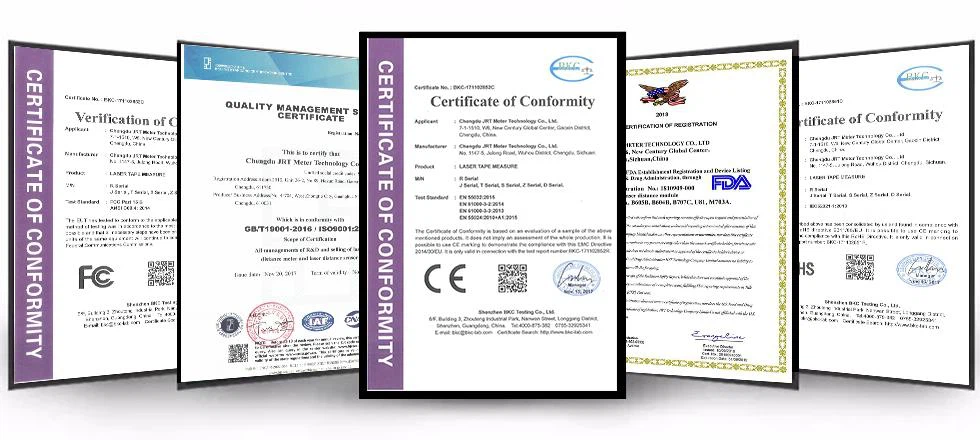
Certifications


productcate-1-1

 
Our Factory


We start as a technical services company, now we are the biggest laser distance sensor manufacture in china. In 2018, our u81, smallest phase-shift laser distance sensor is on market. In 2019, we started to produce lidar sensor. We are always r&d new and better laser sensors for all customers.

productcate-1-1

 
FAQ
 

Q: What is a pressure transducer used for?

A: A pressure transducer is a device that measures the pressure of a fluid, indicating the force the fluid is exerting on surfaces in contact with it. Pressure transducers are used in many control and monitoring applications such as flow, air speed, level, pump systems or altitude.

Q: What is the difference between a pressure transducer and a pressure transmitter?

A: Transducers and transmitters are virtually the same thing, the main difference being the kind of electrical signal each sends. A transducer sends a signal in volts (v) or millivolt (mv) and a transmitter sends a signal in milliamps (ma).

Q: What is an example of a pressure transducer?

A: Gauge pressure transducers measure the pressure relative to local atmospheric pressure. An example is a tire pressure sensor. Another example would be a vacuum sensor, whose signals are reversed so that they signal positive when the measured pressure is below atmospheric pressure.

Q: How is a pressure transducer installed?

A: The transducer is installed in the system by means of its pressure fitting, which can be either an internal or external threaded connection. The thread itself can be either a tapered pipe thread or a straight thread with an "o" ring or plug seal.

Q: What are the types of pressure transducer?

A: There are different types of pressure transducers and these include resistive pressure transducers (strain gauge), capacitive pressure transducers, inductive pressure transducers, potentiometric pressure transducers, resonant wire pressure transducers, piezoelectric pressure transducers, and piezoresistive pressure.

Q: How do you test a pressure transducer?

A: In order to test a pressure transducer, you need to connect the transmitter to the multimeter and use the suitable excitation voltage to excite the transmitter. At zero load, measure the transmitter's voltage output.

Q: How does a pressure sensor works?

A: Most pressure sensors work using the piezoelectric effect. This is when a material creates an electric charge in response to stress. This stress is usually pressure but can be twisting, bending, or vibrations.

Q: Is a pressure transducer a sensor?

A: A pressure transducer is defined as a transducer that converts an input mechanical pressure into an electrical output signal (pressure sensor definition). There are several types of pressure transducers based on size, capacity, measurement method, sensing technology and output requirements.

Q: What is the difference between a pressure transducer and a transmitter?

A: The textbook definition of transducer is an instrument that measures pressure, load, force, or other states, and converts the reading into an electronic signal. A transmitter also converts a reading into an electronic signal, but it then amplifies, modifies, and sends that signal to a receiver.

Q: Is a pressure transducer a pressure switch?

A: Often referred to as a pressure transmitter, a pressure transducer converts pressure into an analog electrical signal. In contrast to a transducer, a pressure switch only triggers at a specific set pressure.

Q: Does a pressure transducer measure total pressure?

A: The transducer measures the difference in pressure between the pressure in the tube and a reference pressure by measuring the strain on a thin element using an electronic strain gauge, shown in red on the drawing. The reference pressure is arbitrary, but should be noted in any data report.

Q: What are the advantages of a pressure transducer?

A: 1.They are economical, robust, and fast response. 2.They have excellent accuracy, great stability, regulated output, and appropriate linearity. 3.They are fast response, highly sensitive, and tiny size measurement instruments.

Q: What is the difference between pressure transducer?

A: The transducer converts pressure into an analog electronic output signal, typically as a millivolt per volt output. These signals are not linearized or temperature compensated. A pressure transmitter has additional circuitry that linearizes, compensates, and amplifies the signal from a transducer.

Q: What are the characteristics of a pressure transducer?

A: A pressure transducer is the next level of sophistication. In a pressure transducer, the sensor element and housing are in electrical contact and have a pressure connection. Typical output signals from pressure transducers are between 10 mv and around 100mv, depending on the sensor type.

Q: Is a pressure transducer a sensor?

A: A pressure transducer is defined as a transducer that converts an input mechanical pressure into an electrical output signal (pressure sensor definition). There are several types of pressure transducers based on size, capacity, measurement method, sensing technology and output requirements.

Q: What are the applications of pressure transducer?

A: Measuring inlet, outlet or system pressure in engine test setup. Measuring pressure drops in a line for preventive maintenance. Measuring fluid height or level in tanks. Measuring the pressure of slurry/slush using a flush diaphragm pressure transducer.

Q: Is a manometer a pressure transducer?

A: Transducers and manometers are devices for measuring pressure. Pressure is the sum of all the forces of a fluid (gas or liquid) applied against a surface divided by the area of the applied force (p = f / a). Absolute pressure is zero-referenced against a perfect vacuum.

Q: What is the primary sensing element in pressure transducer?

A: Pressure transducers, either intravascular or extravascular type, are mostly primary–secondary type. The primary transducer or sensor is the element that is in contact with the pressure pulse, and generally is a displacement transducer, which transduces the pressure wave into a mechanical displacement.

Q: Is a pressure transducer the same as a pressure sensor?

A: A pressure sensor is a device that senses - or measures - pressure. It will have some kind of output that you can see with your eyes or read into a data acquisition system or understand in some fashion. A transducer is a device that converts energy from one form to another.

Q: What is the output of a pressure transducer?

A: Traditional pressure transducer outputs include 0-5v and 0-10v signals. Popularized in europe, zero based output signal produce no output signal at zero pressure in a standard gauge pressure transducer. Transducers are offered in three wire and four wire configurations with zero based output signals.

As one of the most professional pressure transducer manufacturers and suppliers in China, we're featured by customized products with low price. If you're going to wholesale bulk cheap pressure transducer, welcome to get quotation from our factory. Also, OEM service is available.

(0/10)

clearall