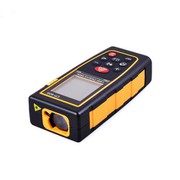
Principle And Application Of Laser Ranging Sensor:
Aug 24, 2019
Principle and application of laser ranging sensor:
* Development of laser distance sensor Laser is widely used in the field of detection, and its technical content is very rich, and its impact on social production and life is also very obvious. Laser ranging is one of the applications of lasers. This is because the laser has many advantages such as strong directivity, high brightness, and good monochromaticity. Although laser ranging is simple in principle and simple in structure, it was mainly used in military and scientific research, but it is rare in industrial automation. Because the price of laser ranging sensors is too high, usually in the thousands of dollars, now domestic distance measuring sensors generally only need a few thousand RMB (Shenzhen Quantum Technology Co., Ltd.). In fact, many industrial users are looking for a sensor that can achieve precise distance detection over long distances. Because in many cases the proximity of the sensor will be limited by the physical location and production environment, today's laser range sensors will solve the problem for engineers in such situations. *Working principle When the laser sensor is working, the laser pulse is first directed to the target by the laser diode.
The laser scatters in all directions after being reflected by the target. Part of the scattered light is returned to the sensor receiver, which is received by the optical system and imaged onto the avalanche photodiode. The target distance can be determined by recording and processing the time elapsed from the time the light pulse is emitted until the return is received. Laser sensors need to accurately measure transmission time. * Solve problems that cannot be solved by other technologies. Laser distance sensors can be used in applications where other technologies cannot be used. For example, when the target is very close, the calculation of a common photoelectric sensor from the target reflected light can also perform a large number of precise position detection tasks. However, when the target distance is far or the target color changes, the ordinary photoelectric sensor is difficult to cope with. Although the advanced background noise suppression sensor and the triangulation sensor work well in the case of a target color change, the predictability of performance is deteriorated when the target angle is not fixed or the target is too bright. In addition, the triangulation sensor is generally limited to within 0.5m. Ultrasonic sensors are also often used to detect objects that are far apart, and because they are not optical devices, they are not affected by color changes. The disadvantages of the ultrasonic sensor are as follows: 1 The object to be tested is not perpendicular to the transducer of the sensor. Because the target of the ultrasonic inspection is within a range of no more than 10° from the vertical azimuth of the sensor. 2 Where the beam diameter is small. Because the general ultrasonic beam is 0.76 cm in diameter when it is 2 m away from the sensor. 3 Where the visible spot is required for position calibration. 4 windy occasions. 5 vacuum occasions. 6 Where the temperature gradient is large. Because this situation will cause a change in the speed of sound. 7 need to respond quickly. The laser distance sensor can solve the above detection in all cases. 4. Widespread use in the field of automation Today, in addition to ultrasonic sensors and ordinary photoelectric sensors, the automatic detection and control method has added a new method that can solve long-distance measurement and inspection - laser distance sensor.