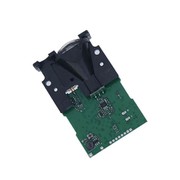
Laser ranging technology
Nov 28, 2019
Laser distance measuring uses laser as the light source for distance measurement. Divided into continuous laser and pulse laser according to the way the laser works. Gas lasers such as helium neon, argon ion, thorium cadmium, etc. work in continuous output state for phase laser ranging; dual heterogeneous gallium arsenide semiconductor lasers for infrared ranging; solid lasers such as ruby and neodymium glass for Pulsed laser ranging. Compared with the photoelectric rangefinder, the laser rangefinder can not only work day and night, but also improve the ranging accuracy.
Laser rangefinders generally use two methods to measure distance: pulse method and phase method. The pulse method ranging process is as follows: the laser emitted by the rangefinder is reflected by the measured object and then received by the rangefinder, and the rangefinder simultaneously records the laser round-trip time. Half the product of the speed of light and the round-trip time is the distance between the rangefinder and the object being measured. The accuracy of distance measurement by pulse method is generally around +/- 10 cm. In addition, the measurement blind zone of such a rangefinder is generally about 1 meter.
Method:
Usually, precise distance measurement requires the cooperation of total reflection prisms, and the range finder used for house measurement directly measures the smooth wall reflection, mainly because the distance is relatively short, and the signal strength of the light reflected back is large enough. It can be known from this that it must be vertical, otherwise the return signal is too weak to obtain accurate distance. Usually it is also possible. In actual engineering, a thin plastic plate is used as the reflecting surface to solve the problem of serious diffuse reflection. Laser rangefinder accuracy can reach 1 mm error, suitable for a variety of high-precision measurement applications.