Safety of Laser Ranging Sensors
Aug 15, 2022
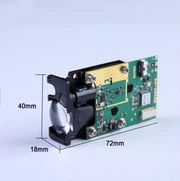
Today, the rapid development of laser technology has led to technological innovation in the field of laser distance sensors. As the name suggests, laser distance sensors use lasers as the main working material.
At present, the laser measurement materials on the market mainly include: semiconductor lasers with working wavelengths of 905 nm and 1540 nm, and YAG lasers with working wavelengths of 1064 nm.
Internationally, there are unified classification and unified safety warning signs for lasers. Lasers are generally divided into four categories (Class1 to Class4). Class I lasers are safe for the human body, Class II lasers are less harmful to the human body, and Class III and Class IV lasers are more harmful to the human body, so special attention should be paid to avoid direct contact with human eyes.

The laser distance sensor uses pulse or phase measurement, and the laser beam is a very concentrated monochromatic light source, so when using the laser distance sensor, do not point your eyes or observe a smooth reflective surface to avoid injury. Therefore, the user must follow the instructions in the safe operating procedures. When taking outdoor measurements, do not point directly at the sun to avoid burning the instrument components.
JRT 's products mainly use Class I and Class II lasers as working materials, which are much safer than other types of lasers. You can choose our products with confidence!

If you want to know more knowledge of our sensors, please talk to us!
Notes:
Laser: The full name is Light Amplification by Stimulated Emission of Radiation. Nd.
YAG: from (Neodymium-doped YttriumAluminiumGarnet; Nd: Y3Al5O12) or Chinese called yttrium aluminum garnet crystal.
Chengdu JRT Main Ranging Sensors: Industrial Laser Distance Sensor, Laser Distance Meter Sensor, Long Rangefinder Module, TOF High Frequency LiDAR Sensor.
For more info, please feel free to contact us.